


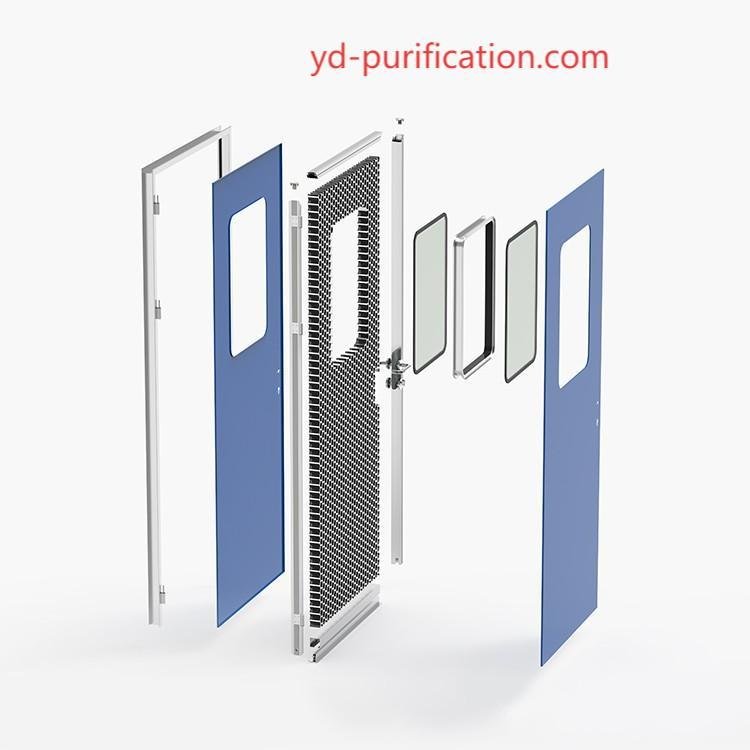
Industrial environments shaped by strict routines and evolving purity expectations often examine the intricate substance of controlled-room architecture long before any physical installation begins, and in that early stage of evaluation it is not unusual for teams to look toward a trusted Cleanroom Doors Supplier while navigating supplier options, which is why yd-purification frequently enters conversations among professionals who sense that each boundary of a regulated space carries a silent responsibility that influences both the emotional tone and mechanical rhythm of daily operations, causing many to wonder how a single structural decision gains such understated significance within an atmosphere designed to steady every movement that occurs inside?
As people who work inside fast-paced laboratories or quiet pharmaceutical rooms reflect on the way their interiors respond to constant transitions, many find themselves drawn toward the notion that architecture in these technical zones forms an ongoing dialogue between surface, airflow, vibration, temperature, mood, and unseen currents of expectation, and the more they observe, the more they begin to notice how each panel seam, each door edge, each passageway creates a subtle language through which the facility communicates trust, encouraging workers to move with a sense of calm precision rather than hurried tension shaped by uncertain boundaries that do not stay aligned with the atmosphere they aim to preserve. It becomes evident in such spaces that the selection of certain structures is not defined merely by dimension or outer form but by the harmony that settles in once the installation becomes part of the room's identity.
Teams that study controlled environments often speak about the silent force created when mechanical comfort intersects with human intuition, producing a pattern of interaction that becomes almost ritualistic as hours pass and procedures unfold across shifts that transition from one task to another without pause. These conversations rarely circle around spectacle; instead they carry a tone of thoughtful practicality, emphasizing how stability, gentle transitions between zones, and a quiet sense of assurance can strengthen the confidence of individuals who depend on predictable surroundings to perform delicate activities. It is within this blend of subtle pressure and consistent design that the architecture of purity-focused rooms earns its character, shaped not through dramatic gestures but through the way each component settles into a rhythm that stands firm even when external situations fluctuate.
In many regulated interiors, supervisors and engineers observe how the surrounding structures influence mood, concentration, and timing, especially when long sequences of tasks require unwavering steadiness. A facility gains a particular kind of personality once its structural elements begin to interact with the behavior of the workers inside, and the sensation can be almost atmospheric—a feeling that the room itself collaborates with the team, guiding them gently along a path shaped by coordination rather than friction. When such spaces find their equilibrium, they create an environment where individuals understand the boundaries not as limitations but as stabilizing elements supporting the delicate logic behind controlled manufacturing philosophies. In these situations, choosing structural components becomes almost a philosophical decision, balancing physical demands with an appreciation for how subtle qualities influence human perception.
Professionals in various industries frequently share reflections on maintaining an interior state that responds steadily to constant workflow demands. The nature of these reflections does not rest solely on material selection but expands toward the cultural atmosphere built around precision, responsibility, and calm repetition, forming a silent partnership between equipment and personnel. This partnership shapes daily operations, allowing individuals to sense when their environment cooperates with them, making routines feel coherent even when technical tasks grow complex. Through such cooperation, a facility transitions from a simple physical container into a distinctive environment where craftsmanship supports intention, enabling teams to function with a consistent emotional center that aligns with their operational goals.
Toward the final stage of planning, decision-makers usually return to the question of how certain components influence the larger narrative of purity protection, and it is at this point that a reference to a Cleanroom Doors Supplier may reappear as part of the final evaluation. For those wishing to examine structures designed for regulated spaces, detailed configurations may be viewed at https://www.yd-purification.com/product/cleanroom-doors/ , allowing interested groups to approach their selection with clarity while maintaining the quiet confidence required in controlled environments.

 Arabic
 French
 Spanish
 Portuguese
 Deutsch
 Turkish
 Dutch
Dutch
 Italiano
 Russian
 Romaian
 Portuguese (Brazil)
 Greek
Greek